Views: 0 Author: Site Editor Publish Time: 2026-09-08 Origin: Site
Sleep quality directly dictates guest satisfaction scores. A single poor night of sleep generates negative reviews, while consistent comfort drives repeat bookings. Commercial buyers face a strict balancing act. You must merge universal comfort profiles with heavy-duty durability. Strict compliance standards complicate procurement further. Budgets vary drastically across different property tiers, requiring strategic allocation of resources. We will evaluate 2027’s top hotel mattresses by focusing on structural integrity and objective testing methodologies. Material science drives long-term performance in high-turnover environments. Superficial marketing claims fail under commercial strain. True commercial beds require rigorous engineering, reinforced perimeters, and specialized foam densities. This guide breaks down the exact specifications, construction types, and procurement strategies needed to secure beds that withstand years of continuous use while keeping guests satisfied.
Universal Comfort is Quantifiable: A medium firm hotel mattress remains the industry standard, accommodating the widest range of sleep positions, body weights, and specific guest needs (such as back pain relief).
Construction Dictates Lifespan: Hybrid and pocket spring designs offer superior edge support, motion isolation for shared beds, and airflow compared to all-foam alternatives in high-turnover environments.
Objective Testing Overrides Subjective Feel: Relying on consistent firmness scales, pressure mapping, and expert durability testing ensures a reliable guest experience across hundreds of rooms.
Compliance is Non-Negotiable: Commercial buyers must prioritize strict fire retardancy standards (16 CFR Part 1633) and material safety certifications (CertiPUR-US, OEKO-TEX).
Residential beds fail quickly under commercial strain. A true commercial bed requires reinforced perimeters and high-density core materials. Continuous use demands resilient structures. Guests subject beds to unpredictable stress daily. They sit on edges to work on laptops. Children jump on the surfaces. Housekeeping flips and rotates units constantly during room turnovers. Commercial success requires industrial-grade materials. High-density foams resist early sagging. Heavy-gauge steel coils prevent structural collapse.
True commercial beds undergo mechanical durability testing before hitting the market. Machines roll heavy weights across the surface thousands of times. This simulates years of accelerated wear. The Cornell test measures structural integrity by applying repeated impacts to the core. The Rollator test evaluates foam degradation over time. Beds passing these tests guarantee a longer functional lifespan in hospitality settings. Beyond core testing, the outer fabric must survive rigorous abrasion testing. The Wyzenbeek test measures how many double rubs a fabric can withstand before tearing. Commercial covers require high double-rub ratings to survive constant friction from heavy linens and mattress protectors.
Universal comfort requires a delicate balance. A medium firm hotel mattress hits the exact sweet spot. It scores a 6 to 7 on objective firmness scales. This specific profile yields the lowest complaint rate across diverse demographics. Back sleepers receive necessary lumbar support. Side sleepers get adequate shoulder relief. Stomach sleepers avoid lower back arching.
Plush pillow-tops or Euro-tops provide initial pressure relief. They cushion the joints immediately upon lying down. They maintain the firm core support underneath. This dual-action design prevents guest complaints of back pain. Motion isolation matters deeply for shared rooms. Guests sharing a bed hate sleep disruptions. Independent coil movement stops motion transfer. One sleeper turning over does not wake the other.
To address common guest pain points, commercial designs focus on specific structural solutions:
Lower Back Pain: Addressed through zoned coil systems that provide firmer support in the center third of the bed.
Shoulder Pressure: Mitigated by incorporating a 2-inch layer of low-ILD memory foam in the Euro-top.
Overheating: Solved by utilizing open-cell foams and breathable natural fiber covers.
Partner Disturbance: Eliminated by using individually wrapped coils rather than continuous wire systems.
Edge support defines the usable surface area of the bed. Weak edges make a queen bed feel like a full size. Guests roll toward the center or slip off the side. High-density foam encasements prevent edge sagging. Heavy-gauge border coils keep the perimeter firm. Guests sit on the edge to tie shoes or watch television. Weak edges collapse and ruin the visual aesthetic of the room. A sagging edge indicates a failing bed to the guest. Robust perimeter reinforcement extends the functional life of the entire unit. Manufacturers often use butterfly supports along the sides. These metal inserts provide extra rigidity where guests sit most frequently.
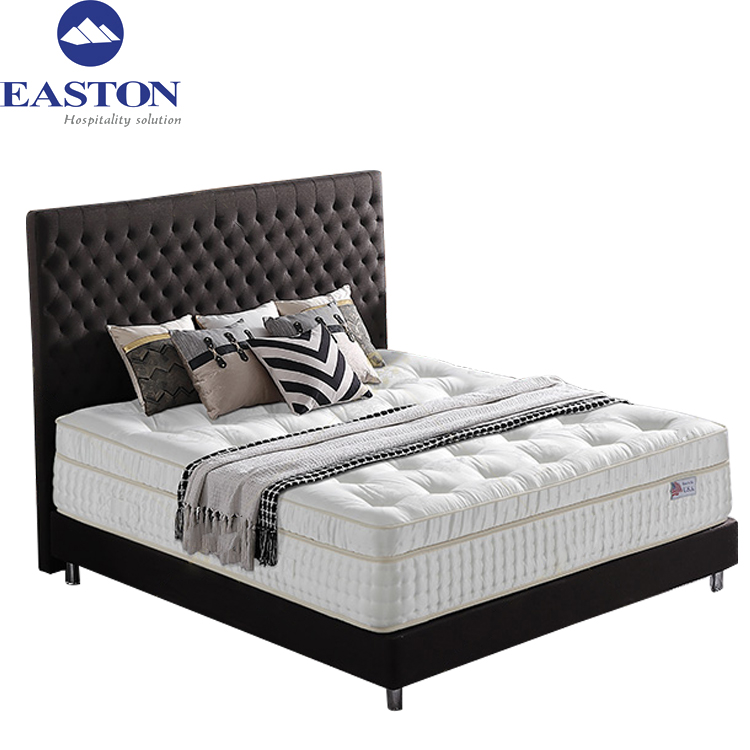
The pocket spring hotel mattress dominates the modern hospitality market. Manufacturers wrap individual coils in fabric pockets. These coils compress independently of one another. They target pressure points precisely. They offer superior motion isolation compared to tied coils. Coil count and gauge dictate longevity. Lower gauge numbers mean thicker steel. Thicker steel sustains heavy use over years. A high coil count distributes body weight evenly. The fabric wrapping prevents metal-on-metal squeaking. This ensures a silent sleep environment. A standard commercial queen should feature between 800 and 1000 individual coils. The perimeter coils should utilize a 13-gauge wire, while the interior coils can use a 14.5-gauge wire for better contouring.
Hybrid architectures represent the luxury standard. They combine pocketed coils with latex or high-density memory foam. This trend rules luxury residential and boutique commercial spaces. Hybrids weigh more and cost more to manufacture. They deliver a deep enveloping feel. The foam layers contour to the body. The coil core provides pushback and support. Breathability remains high due to the open coil structure. Air flows freely through the base. This dissipates the heat trapped by the top foam layers. Hybrids offer the best of both material worlds.
Commercial hybrids require high-density foams. Polyurethane foam layers must meet a minimum density of 1.8 pounds per cubic foot. Memory foam layers should exceed 3.0 pounds per cubic foot to prevent premature body impressions. Understanding foam firmness requires looking at ILD (Indentation Load Deflection) ratings. A comfort layer typically uses foam with an ILD between 12 and 20, providing a soft initial feel. The transition layers beneath require an ILD of 25 to 30 to prevent the sleeper from bottoming out against the steel coils.
Traditional innersprings use continuous wire coils. All coils connect together. When one moves, they all move. They are becoming obsolete in luxury tiers. Motion transfer is severe. They remain viable for budget and economy properties. They are lightweight and inexpensive. Within this category, Bonnell coils represent the cheapest option, featuring an hourglass shape that degrades quickly. Offset coils offer a slight upgrade with a hinged effect for better contouring, but they still fail to isolate motion. Continuous wire systems use a single piece of wire woven throughout the entire bed, creating a highly durable but incredibly bouncy surface.
All-foam beds carry severe risks in commercial settings. They retain heat and cause night sweats. Hot sleepers leave negative reviews. Accelerated degradation happens quickly. Foam softens permanently under continuous heavy use. Edge support is typically nonexistent in pure foam designs. Housekeeping staff also struggle with all-foam beds. They lack rigid structures, making them difficult to lift when changing heavy linens.
Objective testing removes guesswork from procurement. Use expert testing data and pressure mapping. Pressure mapping uses sensor pads to visualize weight distribution. Red zones indicate high pressure points. Blue zones indicate even support. Standardized firmness ratings guide data-driven decisions. Rely on a 1-10 scale to compare different models accurately.
Firmness Rating (1-10) | Feel Category | Target Sleeper Profile | Commercial Suitability |
|---|---|---|---|
3 - 4 | Plush / Soft | Lightweight side sleepers | Poor. Degrades quickly, causes back pain for heavy guests. |
5 - 6 | Medium | Combination sleepers | Good. Works well for boutique properties with diverse guests. |
6.5 - 7.5 | Medium-Firm | Back, stomach, and side sleepers | Excellent. The universal industry standard for durability and comfort. |
8 - 9 | Firm / Extra Firm | Heavyweight back sleepers | Niche. Too hard for most guests, leads to joint pain complaints. |
Temperature regulation ensures uninterrupted sleep cycles. Hot sleepers wake up frequently. Cooling technologies actively pull heat away from the body. Phase-change materials absorb and release thermal energy. Gel-infused foams sleep cooler than traditional memory foam. Naturally breathable materials perform exceptionally well. Organic cotton and wool wick away moisture. Wool acts as a natural thermoregulator. It keeps guests warm in winter and cool in summer. Temperature neutrality prevents negative reviews complaining about stuffy rooms. Avoid synthetic polyester covers. They trap heat and create a clammy sleeping environment.
Commercial lifespans average 5 to 7 years. Residential beds might last 10 years or more. Commercial use accelerates physical wear. Analyze warranty fine print carefully. Look for non-prorated terms. Prorated warranties lose value over time. Check indentation depth requirements. Some warranties only cover sagging deeper than 1.5 inches. Understand void clauses. Stains or improper bed bases often void the warranty entirely. Plan replacement cycles based on objective degradation, not just the calendar. Conduct annual physical inspections. Measure body impressions using a straight edge and a ruler. Replace units that show impressions deeper than one inch.
Regulatory compliance is mandatory. Federal flammability standards are strict. Beds must pass 16 CFR Part 1633 open flame tests. This prevents rapid fire spread in commercial buildings. Eco-friendly certifications matter to modern guests. Look for GOTS (Global Organic Textile Standard). Seek GREENGUARD Gold for low VOC emissions. CertiPUR-US ensures foams lack harmful chemicals. They contain no heavy metals, ozone depleters, or toxic flame retardants. Promoting these certifications enhances property marketing. Keep compliance certificates on file. Fire marshals frequently request these documents during routine property inspections.
Standardizing room layouts simplifies daily operations. The hotel queen mattress offers a massive strategic advantage. It provides maximum inventory flexibility. You can fit two queens in a standard double room. You can place one queen in a smaller single room. It carries universal guest appeal. Couples fit comfortably. Solo travelers enjoy the extra space. Linen procurement becomes highly streamlined. You only order one size of sheets, protectors, and duvets. This reduces storage complexity and laundry sorting errors. Housekeeping efficiency increases when staff do not have to search for specific sheet sizes on their carts.
King sizes fit luxury suites perfectly. They fill large floor plans visually. Custom sizes require bespoke linens. Avoid custom shapes unless absolutely necessary. Split-king configurations ease logistical headaches. A split-king consists of two twin XL beds pushed together. They allow easier transport through narrow corridors and tight elevators. Setup takes less physical effort from staff. They offer modular room configurations. You can separate them for guests requesting twin beds. You can bridge them for couples. Use a high-quality foam bridge pad to eliminate the gap between the two units. Secure the beds together with heavy-duty connecting straps.
Profile heights impact room aesthetics directly. Thickness typically ranges from 11 to 14 inches. Thicker beds look more luxurious. They sit higher off the floor. They dictate fitted sheet depth requirements. A 14-inch bed requires deep pocket sheets. Standard sheets will pop off the corners during the night. Exposed bare corners look unprofessional. Match your linen orders to your specific profile heights. Consider the height of the bed base as well. The total height from floor to top should accommodate elderly guests easily. A combined height of 24 to 26 inches represents the ideal ergonomic target for getting in and out of bed safely.
Align procurement strategies with property tiers. Economy properties need value-focused continuous innersprings. They prioritize low upfront expenditure. Mid-scale properties rely on durable pocket springs. They balance longevity with guest comfort. Luxury boutiques demand premium hybrids. They compete directly on sleep quality. Finding hotel mattresses for sale requires strategic vendor selection. Do not buy residential models for commercial use. They will fail fire codes and durability tests. Request physical cutaways from vendors. Inspect the internal layers visually before signing a contract.
Direct-to-Consumer brands now offer hospitality programs. They leverage strong residential brand recognition. Guests recognize the names from online marketing. Traditional commercial bedding manufacturers still dominate volume orders. They have established supply chains. They understand commercial fire codes intimately. They offer robust commercial wholesale networks. Compare the warranty terms between DTC and traditional wholesalers. Ensure the DTC brand actually provides a commercial-grade variant, not just a residential bed at a discount. Verify their ability to handle large-scale freight logistics.
Minimum Order Quantities dictate your negotiation leverage. Small boutique hotels might struggle to meet high MOQs. Look for distributors that aggregate orders. Volume discounts apply heavily to bulk purchases. Ordering 500 units yields vastly different terms than ordering 50. Contract structures lock in supply chains. Negotiate staggered delivery dates. You do not want 500 beds arriving on the same day if you only have staff to install 50. Secure fixed rates for future replacement orders. Establish a clear timeline for manufacturing and transit. Delays in delivery can push back grand openings or room renovations.
Logistics define a successful rollout. White-glove delivery saves hundreds of labor hours. Delivery teams bring the units directly into the rooms. Room installation must be seamless. Old mattress removal and recycling services are essential. Disposing of hundreds of old beds is a logistical nightmare. Include disposal requirements in the procurement contract. Reserve freight elevators in advance. Coordinate delivery windows with property occupancy rates. Never disrupt the guest experience during a refit. Schedule installations between 11:00 AM and 3:00 PM to avoid disturbing sleeping guests.
Understand your property's freight capabilities. Determine if your loading dock can accommodate 53-foot trailers. If not, you must request smaller box trucks, which increases delivery times and costs. Establish a secure staging area on the ground floor to unbox units before moving them to individual rooms. This keeps cardboard and plastic waste out of guest corridors.
New beds require a break-in period. High-density foams and heavy-gauge coils start stiff. A brand-new medium-firm bed feels extra-firm on day one. Accelerate the break-in process before guest use. Mechanical compression tools help if available. Staff can walk softly across the surface to loosen the foams. Temperature affects foam stiffness. Cold rooms make memory foam rock hard. Ensure rooms are heated to standard temperatures before guests arrive. Warn front desk staff about potential initial firmness complaints. Keep a log of room installations to track which units are still in their break-in phase.
Protecting the investment extends the physical lifespan. Mandate waterproof and bed-bug-proof encasements. Spills ruin unprotected foams instantly. Bed bugs force complete unit disposal. Encasements must be breathable. Plastic-feeling covers trap heat and make noise. Replaceable mattress toppers add immense value. They take the brunt of physical wear. You can replace a topper easily. You cannot replace a core unit easily. Toppers adjust firmness dynamically. Keep plush and firm toppers in inventory. Swap them based on specific guest requests. Wash mattress protectors during every room turnover to maintain strict hygiene standards.
Implement a strict rotation schedule. While modern beds rarely require flipping, they absolutely require rotating. Housekeeping should rotate beds 180 degrees every three months. This distributes body impressions evenly across the surface. Document these rotations in your maintenance logs to ensure warranty compliance.
Request commercial tear sheets and compliance certificates from shortlisted manufacturers to verify fire safety standards.
Order sample units for on-site staff testing and pressure mapping validation before committing to a bulk order.
Audit your current linen inventory to ensure fitted sheets match the profile heights of the new beds.
Initiate quotes with wholesale representatives, mandating old unit removal and recycling in the final contract.
A: A medium-firm profile is the universal standard. It typically scores a 6 to 7 on a 10-point firmness scale. This level accommodates back, side, and stomach sleepers simultaneously. It provides necessary lumbar support while offering enough surface give to minimize shoulder and hip pain.
A: Commercial properties generally replace their beds every 5 to 7 years. High-turnover environments accelerate physical wear, foam degradation, and coil fatigue. Objective durability testing and regular housekeeping inspections dictate the exact replacement cycle rather than residential 10-year timelines.
A: Commercial beds feature reinforced perimeters, higher density foams, and heavier gauge steel coils to withstand continuous use. They must also pass strict federal fire regulations, such as 16 CFR Part 1633, which residential beds may not require depending on the jurisdiction.
A: Yes, in commercial settings. Pocket springs provide superior airflow, keeping hot sleepers cool. They offer robust edge support and prevent the accelerated sagging common in all-foam beds. They also isolate motion effectively for guests sharing a room.
A: Yes. Consumers seeking a specific commercial feel can often purchase these beds through dedicated hotel brand portals. Many major bedding manufacturers also maintain hospitality lines available to the public, offering the exact specifications used in luxury properties.
A: Luxury properties typically utilize profiles ranging from 12 to 15 inches thick. This height provides optimal structural support, accommodates multiple comfort layers, and enhances the visual aesthetic of the room. Deep pocket fitted sheets are required for these dimensions.