Views: 0 Author: Site Editor Publish Time: 2026-07-15 Origin: Site
Purchasing luxury towels often leads to unexpected frustration. You invest in premium options, only to watch them lose softness, unravel at the seams, or fail to absorb water after just a few washes. Deceptive marketing terms like "hotel quality" or "spa-like" obscure the actual technical specifications of the fabric. These vague labels make it difficult to evaluate true durability and performance. To make an informed decision, you need a technical, evidence-based framework. Evaluating objective metrics like staple length, Grams per Square Meter (GSM), and weave construction ensures long-term value. By understanding these core elements, you can select high-performance bath linen that maintains its structural integrity and tactile comfort year after year.
GSM Dictates Function, Not Just Quality: A higher GSM (600-900) indicates a denser, more absorbent towel, but requires longer drying times; lower GSM (300-400) is optimal for quick drying and humid climates.
Staple Length is the True Indicator of Durability: Long-staple and extra-long-staple (ELS) cottons (like authentic Egyptian or Turkish) prevent pilling, linting, and premature wear.
Construction Outweighs Material Alone: Double-turned edges, reinforced dobby borders, and specific weave types (terry vs. waffle) determine how a towel set holds up to rigorous laundering.
Care Dictates Lifespan: Improper laundering—specifically the use of fabric softeners and high heat—destroys the absorbency and structural integrity of premium fibers.
Subjective packaging claims rarely reflect actual product performance. You must ignore marketing fluff and look for verified certifications. Standards like OEKO-TEX Standard 100 guarantee the absence of harmful substances. GOTS certification verifies organic farming practices. These objective markers provide a baseline for safety and material authenticity. When evaluating textiles for daily use, relying on standardized testing metrics prevents costly purchasing mistakes.
Many manufacturers rely on a "first-touch" softness illusion. They coat lower-grade towels in chemical silicone softeners. This makes them feel plush in retail showrooms. However, this coating washes off during the first few laundry cycles. It exposes a rough, low-durability weave underneath. You must evaluate the underlying fiber quality rather than showroom texture. A truly high-quality fabric feels substantial and slightly textured before its first wash, softening naturally over time.
Online shopping introduces significant blindspots. Buying solely based on visual aesthetics or color matches is hazardous. Superficial star-ratings often reflect initial impressions rather than long-term performance. You must verify fiber origin, yarn ply, and density before purchasing. These technical details dictate how the fabric will perform over time. Always check the manufacturer specifications for exact material breakdowns.
Staple length is the most critical factor in cotton performance. Short-staple cotton features numerous fiber ends. This leads to micro-breakages, which you experience as lint. Extra-long-staple (ELS) cotton yields smoother, stronger yarns. These continuous fibers resist pilling and absorb moisture much more efficiently. The longer the fiber, the fewer connection points exist within the spun yarn, resulting in a stronger final product.
Understanding GSM requires an objective approach. Grams per Square Meter measures fabric density. Higher GSM does not automatically mean a better towel. You must match the GSM to your specific climate and drying capabilities. A dense 800 GSM towel feels luxurious but stays damp in humid environments. A 400 GSM towel dries quickly and resists mildew.
GSM Range | Primary Characteristics | Best Use Case |
|---|---|---|
300 - 400 GSM | Lightweight, fast-drying, highly breathable | Humid climates, gym use, travel |
400 - 600 GSM | Medium weight, balanced absorbency | Standard daily use, guest bathrooms |
600 - 900+ GSM | Heavy, plush, maximum moisture retention | Dry climates, luxury master bathrooms |
Egyptian cotton is renowned for its high absorbency and dense feel. The Nile River Valley produces fibers with exceptional staple length. This creates a highly durable and plush fabric. However, counterfeit labeling is rampant in the textile industry. You must verify authenticity through the Cotton Egypt Association trademark. Genuine Egyptian cotton requires longer drying times due to its dense moisture retention. It excels in well-ventilated spaces where thick fabrics can dry thoroughly between uses.
Turkish cotton offers a different set of performance benefits. Grown in the Aegean region, it features long fibers with fewer joints. Turkish cotton possesses a unique property: it becomes softer and more absorbent with successive washes. It dries significantly faster than Egyptian cotton. This makes it ideal for quick-drying scenarios and humid climates. The flat weave variations of Turkish cotton also take up significantly less storage space.
Supima represents the highest grade of American-grown Pima cotton. It undergoes strict quality controls to ensure fiber purity. Supima serves as a highly reliable, durable alternative to imported ELS cottons. The fibers are exceptionally strong and hold dye well. This prevents color fading over years of heavy use. Supima textiles maintain their structural integrity even after hundreds of wash cycles.
Alternative blends offer specific trade-offs. Bamboo blends provide extreme softness and natural sheen. However, bamboo rayon often lacks the structural longevity of pure cotton. It can degrade faster under high-heat laundering. Pure linen offers extreme durability and natural antimicrobial properties. It absorbs moisture quickly but lacks the plush, thick feel of terry cotton. Linen requires a break-in period before reaching optimal softness.
Standard bath towels typically measure between 27" x 52" and 30" x 56". They offer adequate coverage for everyday use and fit easily in standard washing machines. Bath sheets provide generous coverage, measuring approximately 35" x 60" to 40" x 70". The added weight and surface area benefit taller individuals. They also suit those who prefer wrapping themselves completely after a shower. Consider your storage space, as bath sheets require significantly more room.
Complementary pieces must follow industry-standard dimensions. Hand towels generally measure 16" x 30". Washcloths should be exactly 13" x 13". Purchasing disproportionate, non-functional sets leads to awkward storage and mismatched aesthetics. Always verify the exact dimensions before finalizing your purchase. Standardized sizing ensures your textiles fold uniformly and stack neatly in your linen closet.
A premium Towel Set requires careful curation. The core bundle should include two bath towels or sheets, two hand towels, and two washcloths. You must ensure consistent GSM across all pieces for uniform performance. Dye-lot matching is also critical. Purchasing pieces individually often results in slight color variations. A cohesive set guarantees uniform aesthetic and functional standards.
Assess your daily usage to determine the exact number of pieces required.
Select a uniform GSM to ensure all items dry at the same rate.
Verify dye-lot consistency by purchasing bundled sets rather than individual pieces.
Measure your storage shelves to confirm they can accommodate the folded dimensions.
Terry cloth relies on loop length and density for absorbency. Zero-twist yarns create a significantly softer feel. They lack the tight twist that binds fibers together. However, zero-twist construction may sacrifice some durability compared to combed, twisted yarns. Twisted yarns withstand heavy friction much better over time. They are the preferred choice for environments requiring frequent, rigorous laundering.
Waffle weave provides distinct functional benefits. The honeycomb structure makes it highly lightweight. It offers an exfoliating texture that many users prefer. Waffle weave boasts rapid drying times. This makes it the ideal choice for damp environments or poorly ventilated bathrooms. The three-dimensional grid pattern increases surface area without adding unnecessary weight.
Traditional flat weaves, often called Peshtemal, are highly versatile. They lack the raised loops of terry cloth. This space-saving design makes them easy to store and travel with. They dry incredibly fast and resist sand accumulation. Flat weaves function well in both bathroom and outdoor settings. Their tight construction makes them highly resistant to snagging and tearing.
Seam construction dictates the lifespan of your textiles. Double-turned, lock-stitched edges are a non-negotiable feature. This specific stitching prevents fraying during aggressive wash cycles. Single-stitched edges will inevitably unravel, rendering the item useless. Inspect the corners of the fabric to ensure the stitching is reinforced and secure.
The dobby or cam border adds structural stability. Low-quality towels suffer from uneven shrinkage at these borders. This causes the fabric to pucker and lose its shape. Premium manufacturers mitigate this by pre-shrinking the border materials. They also use reinforced banding to maintain structural integrity. A well-constructed border keeps the fabric hanging straight and folding flat.
Outdoor environments demand specific textile engineering. A premium Pool & Beach Towel requires a specialized dual-sided construction. Manufacturers often use velour on one side to actively repel sand. The reverse side features an absorbent terry loop to dry the body. This dual functionality is essential for outdoor comfort. The velour side provides a smooth surface for lounging, while the terry side handles moisture management.
Durability factors differ significantly from indoor textiles. UV-resistant dyes are necessary to prevent rapid fading under direct sunlight. Chlorine-resistant fiber treatments protect the structural integrity of the cotton. Without these treatments, a towel exposed to pool chemicals will degrade and tear prematurely. Outdoor textiles must withstand harsh environmental stressors while maintaining their tactile properties.
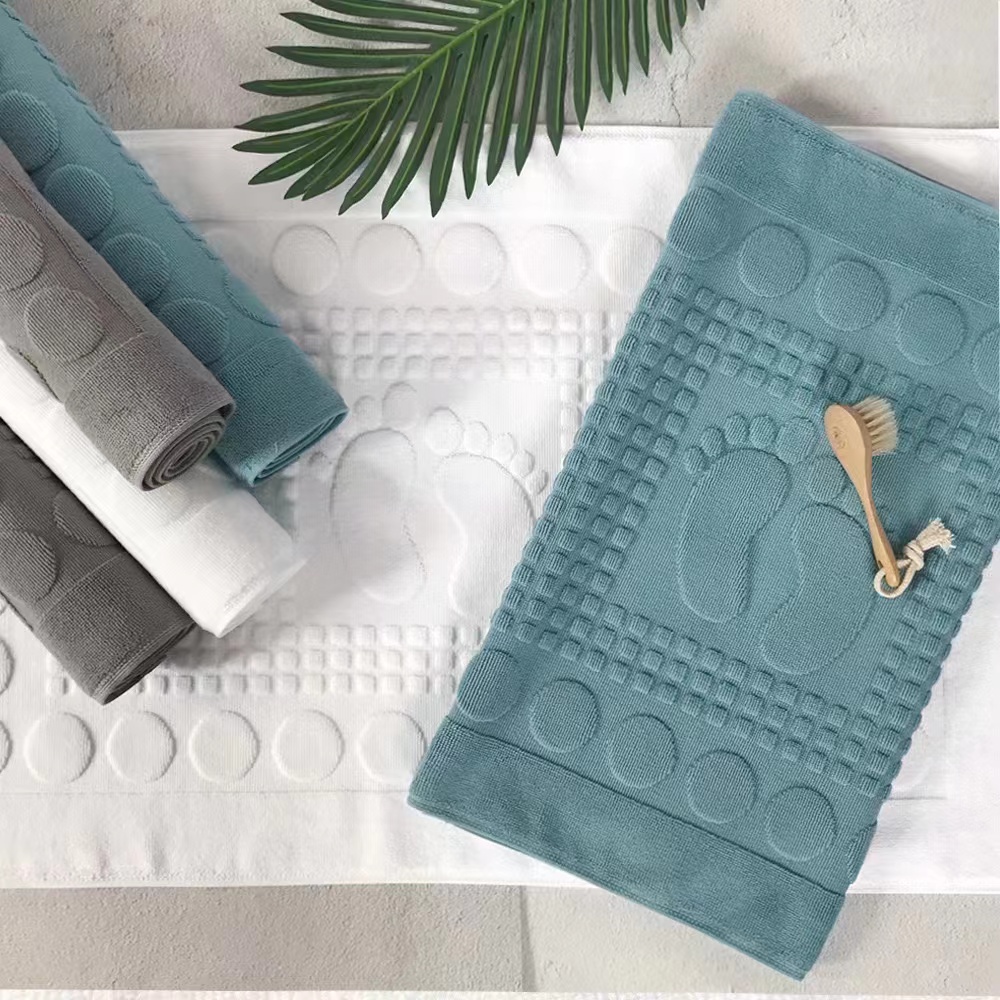
Floor textiles require distinct engineering from body towels. High-performance cotton bath mats require a significantly higher GSM. They typically range from 900 to 1200+ GSM. This extreme density is necessary to withstand heavy foot traffic. It also ensures the mat can absorb substantial standing water without soaking through to the floor. The tight weave prevents the mat from bunching up or sliding easily.
Safety and maintenance present specific trade-offs. Reversible, pure cotton mats are easy to launder at high temperatures. This ensures proper sanitation. Rubber-backed mats offer excellent slip resistance. However, the rubber backing is highly prone to degradation. It will peel and crumble in the dryer over time. Pure cotton options provide superior longevity if you use a separate, replaceable non-slip pad underneath.
Budget towels offer a false sense of economy. They typically have a functional lifespan of one to two years. After this period, they lose absorbency and begin to fray. Properly maintained premium textiles boast a lifespan of five to ten years or more. Investing in high-quality fibers eliminates the constant cycle of replacing degraded materials. You must factor in the replacement frequency when evaluating initial material quality.
Fabric softeners destroy premium cotton. These products, along with dryer sheets, coat fibers in a chemical silicone layer. This renders the cotton hydrophobic, meaning it repels water instead of absorbing it. This completely ruins the functional purpose of the textile. You must eliminate these chemicals from your laundry routine to preserve fiber performance.
Strict washing protocols extend fiber lifespan. Wash items in cold or warm water using mild detergents. Strictly avoid optical brighteners, which weaken cotton fibers. Tumble dry on low heat or utilize line drying. High heat literally bakes the cotton, causing it to become brittle and shed lint. Over-drying is the primary cause of premature textile failure.
Audit your current linen closet to identify missing dimensions or degraded pieces.
Verify material certifications like OEKO-TEX or GOTS before finalizing any selection.
Check manufacturer return policies or trial periods to test absorbency firsthand.
Establish a strict laundry protocol free of fabric softeners and high heat.
A: A high-quality towel generally falls between 400 and 900 GSM. Choose 400-600 GSM for quick drying and humid climates. Select 700-900 GSM for maximum plushness and absorbency in dry, well-ventilated spaces.
A: This is almost always caused by fabric softeners or dryer sheets. These products coat the cotton fibers in a silicone residue. This residue makes the fabric hydrophobic, preventing it from absorbing moisture.
A: Not necessarily. Egyptian cotton is denser and more absorbent, making it feel luxurious. Turkish cotton dries much faster and becomes softer with washing. Your choice depends on your climate and drying preferences.
A: A standard bath towel measures around 27" x 52". A bath sheet is significantly larger, often measuring 35" x 60" or more. Bath sheets provide extra wrapping coverage and surface area.
A: Wash them every one to two weeks in hot water for sanitation. Pure cotton mats can last five to ten years. Rubber-backed mats usually require replacement every one to two years due to backing degradation.
A: Zero-twist means the cotton yarns are not twisted before being woven. This creates an exceptionally soft, fluffy texture. However, it requires very long, strong fibers to prevent the yarn from breaking apart.
A: Chlorine bleach weakens cotton fibers and causes premature yellowing. If you must brighten white textiles, use an oxygen-based bleach alternative. Always wash in warm water with mild detergent to maintain fiber integrity.